

Value Check: Appraising the 1971 Half Dollar
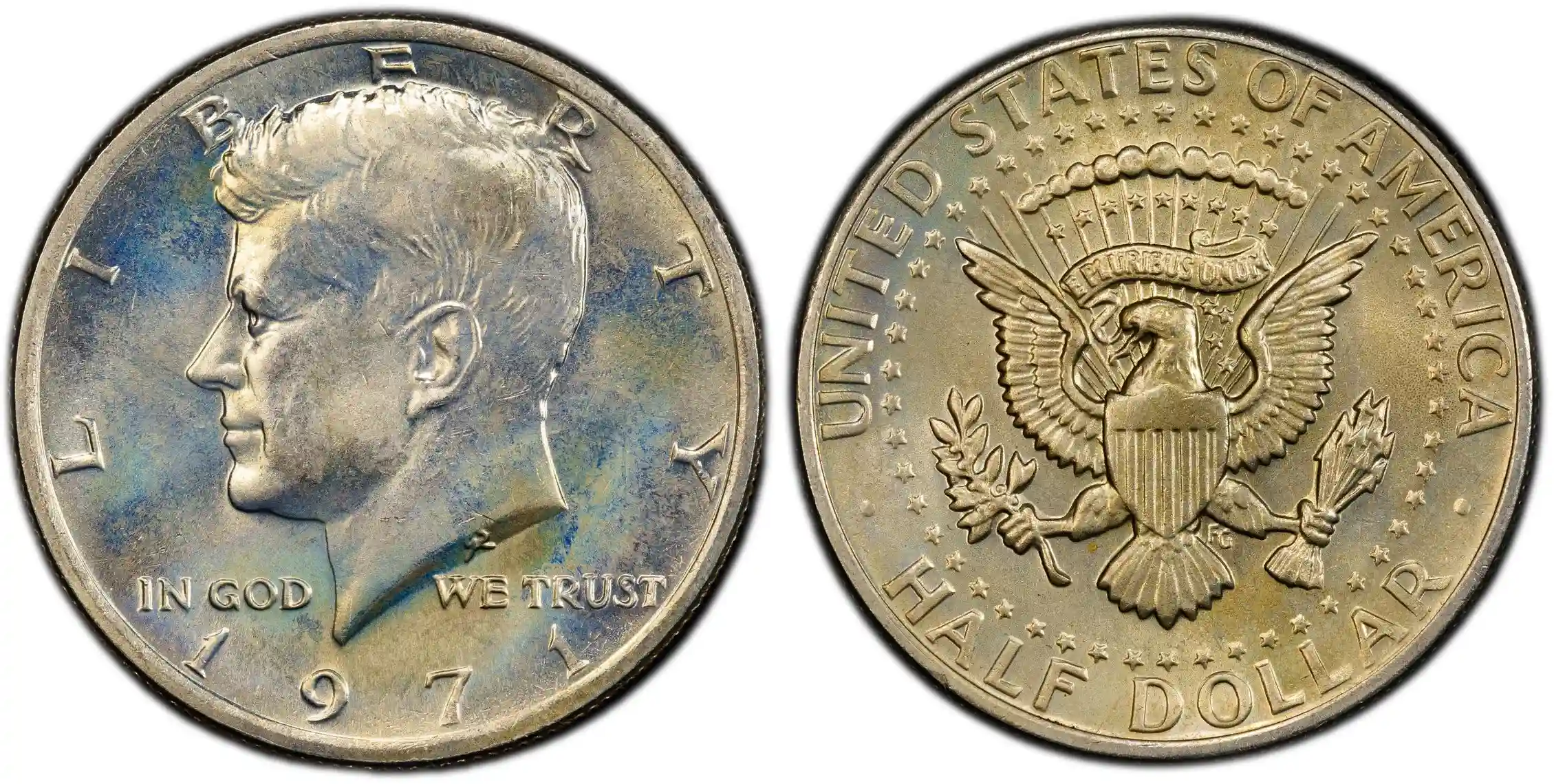
For numismatists, the 1971 half dollar value represents the dawn of the clad period for the half dollar. While many casual observers dismiss these coins as common change, the modern market tells a much more lucrative story for those who know exactly what to look for.
New Copper-Nickel Period in History
From 1964 to 1970, the Kennedy Half Dollar was the last holdout of silver in daily circulation. While dimes and quarters transitioned to base metals in 1965, the half dollar retained a 40 % silver composition through 1970. Rising silver prices and hoarding forced the Treasury's hand.
In 1971, the Mint launched the copper-nickel clad composition as a signal of a new period. The moment the coin’s value derives entirely from the government's decree rather than its metal content.
The Mintage
In the year, the Philadelphia and Denver mints went into overdrive and struck over 450 million coins combined to meet the demand for the new silverless halves. Usually, such massive numbers would kill collector interest.
But a paradox emerged, because these coins were produced so quickly and handled so roughly, high-grade pieces became conditional rarities. Millions exist in poor condition, but only a handful exist in pristine, gem state.
Item Specifications
The 1971 half dollar is a clad coin. This means it features a core of pure copper between two layers of 75 % copper and 25 % nickel. If you look at the edge of a 1971 penny, you will see a distinct brown copper stripe, which is the easiest way to tell it apart from the silver-clad coins of 1965–1970.
Composition | 75 % copper / 25 % nickel |
Weight | 11.34 grams |
Diameter | 30.60 mm |
Edge | Reeded |
The Mints
Philadelphia No Mint Mark – produced 155 million coins. Finding these in top-tier grades is notoriously difficult due to poor storage at the mint.
Denver D – the powerhouse of 1971, striking over 300 million. It is the primary hunting ground for the D over S and silver planchet errors.
San Francisco S – focused on Proof production for collectors and creating coins with mirrored backgrounds and frosted details.
Coin Appraising by Grade
Download the coin value checker free and you will see the three major sections exist:
Circulated Items
Uncirculated Items MS-60 / MS-64
Gem Items MS-65 / MS-67+
Circulated Conditions
If you find a 1971 half dollar in a bank roll today, it is likely worth its face value: $0.50. To be worth more, it must show minimal wear. Look at Kennedy’s hair above the ear. In circulated grades, this becomes a flat blob. On the reverse, check the eagle’s breast feathers; they should have distinct lines, not a smooth surface.
Uncirculated
These are coins that never entered a vending machine or a pocket. They have "mint luster"—that spinning light effect—but are covered in scratches. These sell for $1 to $5.
Gem & Superb Mint State
This is where the appraisal gets exciting. Because the 1971 strikes were often soft, a piece that is sharply struck and scratch-free is a miracle. A 1971 Philadelphia graded MS-67 can command over $15,000 at auction in 2026 because it is a registry-quality coin. Meanwhile, an MS-65 might only fetch $30.
S Proofs
Appraising San Francisco proofs requires a different lens. Most survived in plastic sets, so "Proof-69" specimens are common and worth about $10–$15. Moreover, a Proof-70 is a perfect coin under magnification; it can fetch $500+.
Cameo & Deep Cameo
The most valuable proofs have a stark contrast: a snowy, white frosted portrait of Kennedy against a jet-black, mirrored field. A "Deep Cameo" 1971-S is the gold standard for modern collectors, often doubling or tripling the price of a standard proof.
Feature | Standard Proof | Cameo | Deep Cameo |
Visual Contrast | Little or no difference | Moderate contrast | Intense, high contrast |
Field Reflectivity | Mirrored | Highly mirrored and clear | Deep |
Frost Consistency | Non-existent | Visible frost | Heavy, thick |
Rarity | Common | Common | Rare |
Value | $8–$12 | $25–$45 | $120–$250 |
The massive jump in value for the Deep Cameo is driven by Registry Set competition. Because most 1971-S proofs were found in standard government-issued brown boxes, they often suffered from toning or haze over the decades. Finding a piece that has remained perfectly white with deep frost is a challenge.
When buying 1971-S proofs online, be wary of photo tricks. Sellers often use extreme lighting to make a standard Cameo look like a Deep Cameo. Always look for the DCAM or UCAM designation on the professional grading slab (PCGS/NGC) to ensure the value is authentic.
The Details
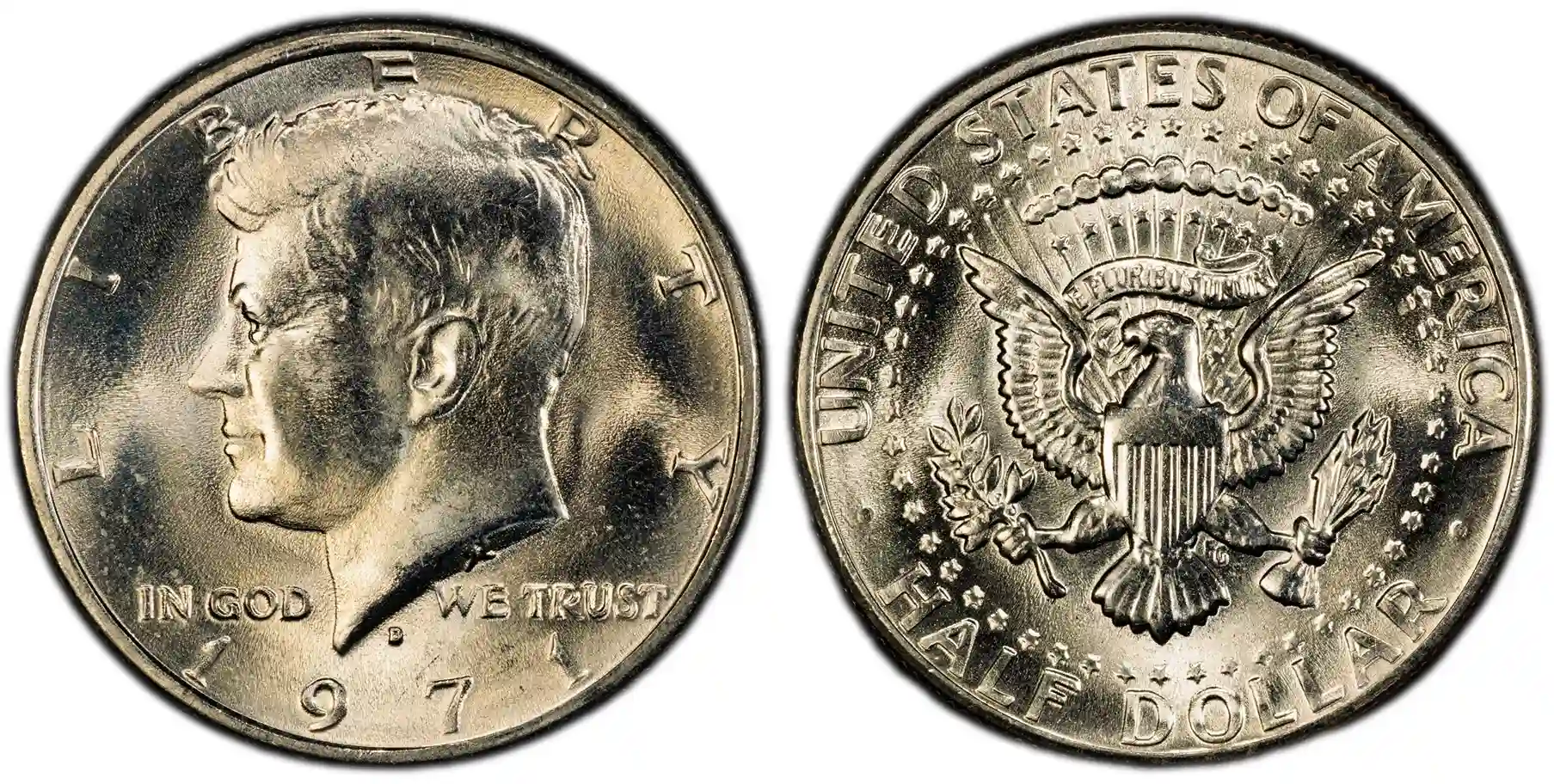
After analyzing information in the coin checker, you will notice the “frosty" devices.
To qualify for Deep Cameo, the frost must be complete. On the 1971-S, look specifically at Kennedy’s hair and the stars on the reverse. If you see shiny bald spots where the frost didn't take, the coin will likely only receive a Cameo or standard proof grade.
The Black Mirror Fields
The fields (the flat areas) of a DCAM coin should be so reflective that they appear black in certain lighting. This is caused by the light being reflected perfectly away from the viewer, rather than scattering off a duller surface.
The Ultra Cameo Equivalent
Note that while PCGS uses the term Deep Cameo (DCAM), NGC uses the term Ultra Cameo (UCAM). These are functionally identical in the marketplace and carry the same value bonuses.
Expert Appraisal Tips: How to Evaluate Your Collection
When to Grade – do not spend $30 to grade a 1971 coin unless it looks virtually perfect to the naked eye. If there is even one visible scratch on Kennedy’s cheek, it likely won't hit the MS-66+ threshold needed to turn a profit.
Photography – when selling online, use axial lighting to show the luster. A dull photo can make a $1,000 coin look like a $0.50 coin.
Avoid the Silver-Plating Trap – many 1971 coins were silver-plated by private companies to sell as collectibles. These have no numismatic value and are generally considered damaged by serious appraisers.